Our Father in heaven (Matthew 6:9)
Our Father (Luke 11-2)
Scientific view of the cosmos
There is continuous effort to reduce the complexity of theoretical explanation of the cosmos into as few fundamental Laws of Nature as possible. The Theory of Everything, a single model describing all aspects of the physical reality, is the so far elusive goal of fundamental research.
A few theories or one - this does not change the fact that in scientific research the Universe is seen as a logical whole setting the content and limits of the world as we know it. It is an iron glad cage made of unbreakable natural laws, something that can be studied experimentally and that can be analysed logically on the basis of what is known.
The fact that so many aspects of the cosmos are unknown, that there new things are discovered that fundamentally change older view like dark energy and dark matter or quantum physics, does not break this cage of natural laws. They are just new additions to the same basic quest for explanation and require modification and expansion, sometimes rejection, of currently commonly adopted views.
Heavenly Father and His Son
There is a natural tendency to understand God of Israel as someone who abodes in the sky, somewhere up there in the heavens. Modern cosmology does not, however, leave room for God's heavenly temple somewhere there behind the stars. It is a singularity, physical reality that works according to the laws of nature - some known and some unknown - with no specific room as the abode of Heavenly Father.
But here exactly the Bible blows into smithereens the natural - and widely adopted and held - mental image of God somewhere up there in the physical sky.
First, there are the apocalyptic texts that describe how sky is opened like a book scroll and a different reality becomes visible to the inhabitants of earth.
Secondly, the miracle stories break the cage of natural laws.
Thirdly, the resurrection of Jesus Christ introduces a completely different and yet somehow similar and linked reality in the existence. Jesus did not return back to this life as many mistakenly think but rather represents something entirely new and different, with roots in this our existence.
Saint Paul goes to great lengths in trying to explain this to the Corinthian Christians using metaphors, how seed is rotten but from its dead looking body grows a new plant.
Multiple reality
Science seeks unifying physical model that explains everything by natural laws. As such it represents a mental cage that is such a source of pride to many atheists.
While Jews and Christians may have confused views of heaven and sky - the concepts are difficult - the Scriptures break the singularity of the cosmos, the One. Certain passages hint without ever giving detailed logical explanations that there is another level of reality hidden from our physical eyes but reachable through personal faith and only through faith.
Tuesday, February 23, 2016


Saturday, February 20, 2016
Heaven up
Three-tier world view is natural to us human beings and found in many different cultures. There is this actual presence, above heavens or some spiritual concept of it, under chtonic world with its creatures and realm of death.
Geocentric view
In the natural geocentric view there is no difficulty of understanding that heavens are up, above the everyday realm of living with all that belongs there. In everyday parlance and daily life we similarly live under the canopy of heaven above us. How the heavens stay up is understood in different ways by different nations and cultures. The Bible uses the concept רָקִ֫יעַ (raqia) usually translated in English as the vault of heaven, the firmament. The waters above it are kept in hold by it, sun, .moon, planets and stars are fixed there and do not fall down before the end of the days. Genesis 1:6,7
The Latin Church developed a comprehensive world view that mapped human existence: we live in this world, God's heaven is up and Hell is down under our feet. The church is the gateway to the eternal bliss in heavens up there.
Heliocentric view
Astronomers introduced the concept of round Earth rotating around the Sun. This began to brake the harmony of the ancient static three-tier cosmology so natural to human mind. What is up, what is down if Earth is in constant movement and not a solid foundation of existence? It took the Church quite a while to adjust the angelic theological teaching that looked so perfect to this new dynamic reality.
The process of making sense of where are heavens goes on also today as believers try to combine Biblical and traditional Christian heritage with the changing realities introduced by Astronomy and Cosmology.
Modern view
Today the world is not understood in Euclidean geometry with up and down but rather as a space-time continuum with its focal point in the Big Bang. Four-dimensional world view is not easy to grasp and not at all as natural to human mind to grasp as the geocentric world view.
Spiritual heaven
We have the old geometry in our confession of faith in the sentences about Jesus Christ who first descendit ad inferos and then ascendit ad caelos, sedet ad dexteram Dei Patris.
However, be warned that the concept of spiritual heaven is quite complex in the Biblical texts and does not equate the sky with its many objects with the abode of God in the heavens of heavens.
Geocentric view
In the natural geocentric view there is no difficulty of understanding that heavens are up, above the everyday realm of living with all that belongs there. In everyday parlance and daily life we similarly live under the canopy of heaven above us. How the heavens stay up is understood in different ways by different nations and cultures. The Bible uses the concept רָקִ֫יעַ (raqia) usually translated in English as the vault of heaven, the firmament. The waters above it are kept in hold by it, sun, .moon, planets and stars are fixed there and do not fall down before the end of the days. Genesis 1:6,7
The Latin Church developed a comprehensive world view that mapped human existence: we live in this world, God's heaven is up and Hell is down under our feet. The church is the gateway to the eternal bliss in heavens up there.
Heliocentric view
Astronomers introduced the concept of round Earth rotating around the Sun. This began to brake the harmony of the ancient static three-tier cosmology so natural to human mind. What is up, what is down if Earth is in constant movement and not a solid foundation of existence? It took the Church quite a while to adjust the angelic theological teaching that looked so perfect to this new dynamic reality.
The process of making sense of where are heavens goes on also today as believers try to combine Biblical and traditional Christian heritage with the changing realities introduced by Astronomy and Cosmology.
Modern view
Today the world is not understood in Euclidean geometry with up and down but rather as a space-time continuum with its focal point in the Big Bang. Four-dimensional world view is not easy to grasp and not at all as natural to human mind to grasp as the geocentric world view.
Spiritual heaven
We have the old geometry in our confession of faith in the sentences about Jesus Christ who first descendit ad inferos and then ascendit ad caelos, sedet ad dexteram Dei Patris.
However, be warned that the concept of spiritual heaven is quite complex in the Biblical texts and does not equate the sky with its many objects with the abode of God in the heavens of heavens.
Wednesday, February 17, 2016
Heaven - Sky (language)
The Free Dictionary defines heaven
The Free Dictionary defines sky
As in English language, also in German the word Himmel may refer to a physical or spiritual heaven or to the physical sky above us.
Usage
Astronomers regularly use the noun sky as it refers to the physical space above us. In Judeo-Christian tradition the heavily loaded word heaven causes much confusion and logical difficulties if the spiritual and physical meanings are not carefully observed.
"In the beginning God created heavens and earth" Gen 1:1 leads directly to confusion about what is meant in the text by the majestic plural shamaim, heavens.
The Free Dictionary defines sky
n. pl. skies (skīz)
In French, heaven is similarly paradise or ciel.
Usage
Astronomers regularly use the noun sky as it refers to the physical space above us. In Judeo-Christian tradition the heavily loaded word heaven causes much confusion and logical difficulties if the spiritual and physical meanings are not carefully observed.
"In the beginning God created heavens and earth" Gen 1:1 leads directly to confusion about what is meant in the text by the majestic plural shamaim, heavens.
Tuesday, December 8, 2015
Lyra theology: names of the stars
 |
| Sheliak, Beta Lyrae image The Star Trek Museum of Science |
The second brightest star in Lyra constellation is called by a proper name, Sheliak. Arab astronomers coined this name الشلياق šiliyāq or Al Shilyāk which they use also as the name of the constellation. Prominent stars on northern and southern sky have been named in this manner with meaningful names in different languages and cultures.
But there are quite many stars also in the small constellation of Lyra and calling them by "personal names" is not practical. When Johann Bayer (1572 – 1625) published the star atlas Uranometria Omnium Asterismorum in 1603 he sorted the stars by their apparent brightness and called them with the constallation name and greek letters, the brightest one being alfa. According to the Bayer designation Sheliak is also known as beta Lyrae (β Lyr, β Lyrae).
The first Astronomer Royal John Flamsteed (1646–1719) published a catalog of 3000 stars in 1711. He abandoned the rather cumbersome Greek lettering scheme and used plain numbers instead. By the Flamsteed designation Sheliak is known as 10 Lyrae without indication of its brightness among the stars in Lyra.
The proper names and Bayer and Flamsteed numbers, as well as some other systems, are still widely used and astronomers are very familiar with them. However, with the growth of the power of telescopes these elegant old systems turn out to be impractical Henry Draper (1837-1882) used photographs to catalog that was expanded to include 225,300 stars. They are named simply by a number preceded by HD (or HDE for the extended map). This kind of abstarct naming is, of course, very hard for human brain to remember.
But there is no alternative. The Hubble Space Telescope Guide Star Catalog uses special codes and running numbers to identify uniquely the guiding lights among the billions of stars it can see up there in orbit around Earth.
Theological point
 |
| "Psalms scroll" by Pete unseth - Own work. Licensed under CC0 via Commons |
מוֹנֶ֣ה מִ֭סְפָּר לַכּוֹכָבִ֑ים לְ֝כֻלָּ֗ם שֵׁמ֥וֹת יִקְרָֽא
He determines the number of the stars
and calls them each by name.
Psalm 147:4 NIV
Psalm 147 was written after the utter destruction of Jerusalem by the Babylonians in 587 BC. Somewhat surprisingly, it inserts a verse about the greatness of God of Israel who calls each star by name. We can deduct from this that there is a divine catalog of all stars in the Cosmos whose quantity is decided by God and who has his own nomenclature for each one of them.
More practically, the psalmist who has seen the totally ruined Temple still expresses faith in the might and power of God the Creator and Caretaker, whose house has been shattered to pieces by followers of Marduk and the holy treasures taken to Babylon.
Nobody could expect it but only a generation or so later the great King Cyrus of Persia conquered Babylon. He gave a degree in 530 BC that exiled Jews are allowed to return home and rebuild their Temple. Faith in God of Israel, who knows every star by a name, was not in vain or empty wishful thinking despite of the horrific tribulations. The Jews would never forget this lesson about their God.
It is likely that this beautiful psalm reflecting the power of God of Israel was written after return from exile in the fifth century BC as it is so full of praise and the horrors of war, destruction and exile seem to be behind.
Psalm 147:4 makes the entire Cosmos intensively personal.
Monday, December 7, 2015
Lyra theology: everything or nothing
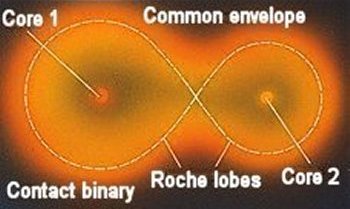 |
| Diagram of a contact binary Image David Darling, The Internet Encyclopedia of Science |
Challenge
The chronologically latest texts in the collection of sacred books called the New Testament are currently dated to second century AD. The bulk of Old Testament was written during and before the Achaemenid Empire and the most ancient parts reaching the Sumerian culture. Accordingly, the writers of the Bible lived some 2000 to 3000 years ago.
For the Biblical writers skylight was thus the light visible to naked-eye. Babylonian world view was dominant in the Levant until the Greco-Roman period. In Old Testament period the position of stars flying high up on the sky was explained with the help of raqia, usually translated vaguely as firmament. It probably was imagined as a kind of cupola over the flat Earth holding up the Sun, Moon, the five visible planets and those countless little twinkling points of light, the stars in heaven.
The ancient Near Eastern and classical period understandings of the relationship between Earth and the stars above is of only historical importance to students of modern Astronomy and Cosmology. it can be studied and compared to other models known, for example, from Indian peninsula, Far East and pre-Columbian Americas (Cultural Astronomy).
Scientific information about the contact binary V361 Lyrae would be totally out of the reach of the writers of the Bible. It is quite recent knowledge about Nature that also the most educated academic minds of the 19th and much of the 20th century had no idea about.
Theological note
בְּרֵאשִׁ֖ית בָּרָ֣א אֱלֹהִ֑ים אֵ֥ת הַשָּׁמַ֖יִם וְאֵ֥ת הָאָֽרֶץ
In the beginning God created the heaven and the earth
Genesis 1:1
The first verse of the Bible is all-inclusive.
Despite of the fact that the writers of the Bible had a very limited geocentric world view, we believe that the Scriptures are inspired by the God of Israel who has created V361 Lyrae.
The opening verse challenges us: either He has created absolutely everything there is, including you and me and is the only true God there is. Or we may conclude that God of Israel has created nothing and is therefore not a true God but a creature of brilliant human minds.
It does not matter how deep we get into the physical characteristics of the contact binary V361 Lyrae, we will not find God there. Modifying the words in St. Augustine's Confessions, also this amazing pair of stars joins all Creature and tells us "He is not here but He has made us."
Sunday, December 6, 2015
Lyra theology:Singularity and the One
Within the boundaries of the constellation Lyra is a multitude of heavenly objects. They look and behave very differently from each other floating among cosmic clouds of dust and being pierced by cosmic radiation.
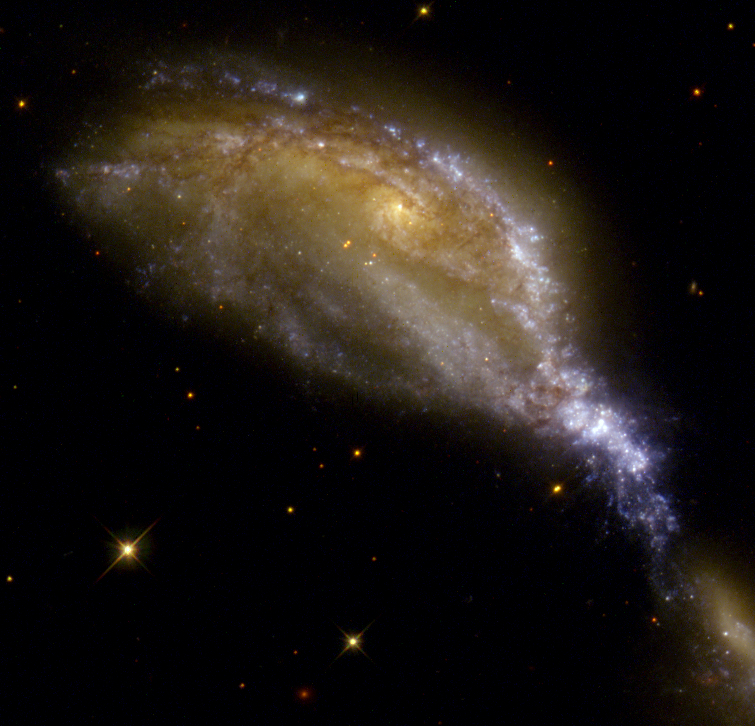
Scientific research has shown that simple light spots, stars seen there by naked eye like Vega, Sheliak, Sulafat or R Lyr, actually represent many different stellar classes and types. In addition to stars, the fiery ring of Messier 57 is a planetary nebula made of the the remains of an exploded star. The colliding galaxies NGC 6745 do not even resemble familiar spiral galaxies. This astronomic crash site has many newborn stars shining as a blue ribbon.
Highly sensitive instruments measuring visible and invisible electromagnetic wavelengths have demonstrated that star light is far from constant but varies in subtle ways. The changes provide astronomers significant information about the shining stars and their companions. 19 Lyr is an Alpha2 Canum Venaticorum variable while V473 Lyrae is a Classical Cepheid variable. Even more sensitive instruments provided data suggesting that Gliese 758 has planet(s).
Challenge
The sky in the direction of Lyra is full of variation, multitude of different classes and types of objects and physical and chemical processes. Many of these objects are gigantic and much larger then Sun. It is therefore rather surprising, that 20th century science took most significant steps in explaining these phenomena by studying the smallest things known to man, atoms and their sub-particles.
Nuclear physics and particle physics are today an essential part of Astrophysics and careful observation, sophisticated mathematical modeling and also experiments in particle accelerators and other instruments provide the data and theoretical foundation for explaining the multitude of objects and their behavior in space.
Accordingly, Cosmology represents a very tightly bound singularity where explanations are reduced to a few fundamental principles such as gravity. Theoretical Physics is actively looking for the Theory of Everything, "a hypothetical single, all-encompassing, coherent theoretical framework of physics that fully explains and links together all physical aspects of the universe.". (Wikipedia)
The scientist who is able to unite the basic Laws of Nature into a single theory will surely be a Nobel price candidate.
Singularity in Cosmos is also apparent from another point of view. With the help of Cepheid variables Edwin Hubble gained understanding of distances not only to stars but to those enigmatic nebulae that were generally considered nothing but dust clouds in the only galaxy, Milky Way. He not only realized that these nebulae were islands of billions of stars, other galaxies in deep space but also noticed that the distance is reflected in the star light showing Red Shift.
As the expansion of the Universe became established a very natural idea rose to the mind of brilliant scholars such as Albert Einstein and his friend Georges Lemaître: since Universe is expanding what happens if we reverse the process? Following this thought Lemaître suggested that in the beginning everything was in a single dot, the Cosmic Egg. British astronomer Fred Hoyle mocked the idea - the believed that Universe is eternal with no beginning or end - and coined in a BBC program the catchy name Big Bang. It is now embedded to most languages as the terminus technicus.
Everything explained by a single theory of Physics, everything having its origins in a single point existing before time.
Theological point
Jewish confession of faith is from Deuteronomy 6:4. It is very simple and extremely deep:
Scientific research has shown that simple light spots, stars seen there by naked eye like Vega, Sheliak, Sulafat or R Lyr, actually represent many different stellar classes and types. In addition to stars, the fiery ring of Messier 57 is a planetary nebula made of the the remains of an exploded star. The colliding galaxies NGC 6745 do not even resemble familiar spiral galaxies. This astronomic crash site has many newborn stars shining as a blue ribbon.
Highly sensitive instruments measuring visible and invisible electromagnetic wavelengths have demonstrated that star light is far from constant but varies in subtle ways. The changes provide astronomers significant information about the shining stars and their companions. 19 Lyr is an Alpha2 Canum Venaticorum variable while V473 Lyrae is a Classical Cepheid variable. Even more sensitive instruments provided data suggesting that Gliese 758 has planet(s).
Challenge
The sky in the direction of Lyra is full of variation, multitude of different classes and types of objects and physical and chemical processes. Many of these objects are gigantic and much larger then Sun. It is therefore rather surprising, that 20th century science took most significant steps in explaining these phenomena by studying the smallest things known to man, atoms and their sub-particles.
Nuclear physics and particle physics are today an essential part of Astrophysics and careful observation, sophisticated mathematical modeling and also experiments in particle accelerators and other instruments provide the data and theoretical foundation for explaining the multitude of objects and their behavior in space.
Accordingly, Cosmology represents a very tightly bound singularity where explanations are reduced to a few fundamental principles such as gravity. Theoretical Physics is actively looking for the Theory of Everything, "a hypothetical single, all-encompassing, coherent theoretical framework of physics that fully explains and links together all physical aspects of the universe.". (Wikipedia)
The scientist who is able to unite the basic Laws of Nature into a single theory will surely be a Nobel price candidate.
Singularity in Cosmos is also apparent from another point of view. With the help of Cepheid variables Edwin Hubble gained understanding of distances not only to stars but to those enigmatic nebulae that were generally considered nothing but dust clouds in the only galaxy, Milky Way. He not only realized that these nebulae were islands of billions of stars, other galaxies in deep space but also noticed that the distance is reflected in the star light showing Red Shift.
As the expansion of the Universe became established a very natural idea rose to the mind of brilliant scholars such as Albert Einstein and his friend Georges Lemaître: since Universe is expanding what happens if we reverse the process? Following this thought Lemaître suggested that in the beginning everything was in a single dot, the Cosmic Egg. British astronomer Fred Hoyle mocked the idea - the believed that Universe is eternal with no beginning or end - and coined in a BBC program the catchy name Big Bang. It is now embedded to most languages as the terminus technicus.
Everything explained by a single theory of Physics, everything having its origins in a single point existing before time.
Theological point
Jewish confession of faith is from Deuteronomy 6:4. It is very simple and extremely deep:
שְׁמַע יִשְׂרָאֵל יהוה אֱלֹהֵינוּ יהוה אֶחָד
Sh'ma Yisra'el Adonai Eloheinu Adonai Eḥad
Hear, O Israel: the LORD is our God, the LORD is One.
Saturday, December 5, 2015
Lyra theology: Perspective
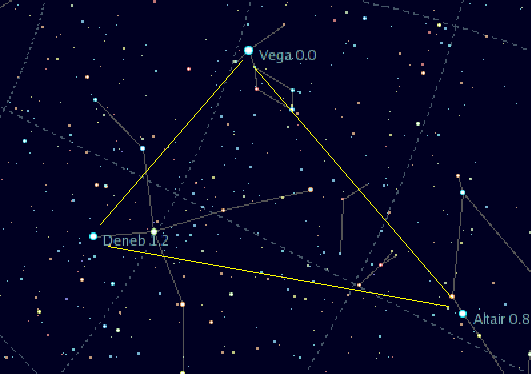 |
| Summer triangle Vega, Deneb, Altair by Jim Thomas. Licensed under GPL via Commons |
Introduction
Even our quick study of some notable objects in the swathe of sky bounded by the borders of the constellation Lyra demonstrates the exponential growth of knowledge about the space achieved by humans. This daily growing information and understanding do pose significant challenges to those adhering to the Judaeo-Christian heritage based upon the Bible.
The impact on faith in the God of Israel is, however, deep and very closely tied to individual believer's familiarity with modern Cosmology and Astronomy. As years go by the scientific information will penetrate deeper to the public consciousness and the questions start to rise. It is safe to assume that currently those twinkling stars and beautiful pictures of galaxies are for great part of humanity rather distant from the general worldview, impractical and curiosity rather then fundamental building blocks of personal world view. There are more pressing things to consider and the science/religion discussions that create excitement among many Christians focus on life sciences, especially evolutionary biology.
Cosmology and Astronomy have deeper impact on Theology than life sciences and can be compared to the rumblings of a massive earthquake under the Church. The following points of Astrotheology are written knowingly as theses without references to other theologians' writings. This independent approach is an invitation to critical discussion and reflection and I plan to introduce at a later point various theological views, particularly from the Roman Catholic church which for centuries has dealt with the issues and has an observatory in Vatican.
The astronomical details mentioned in these theological theses focus on the constellation of Lyra and are discussed previously in this blog under the title Lyra studies written in October-November 2015.
Soli Deo Gloria
Thesis I: Perspective
The challenge
The fifth brightest stars in the night sky is the beautiful Vega in the constellation of Lyra. It is a bluish white main sequence star with spectral class A0V. It is fusing hydrogen to helium like Sun. As it is three times larger than Sun the nuclear reaction happens quickly. The expected life-time is one billion years while astronomers estimate that Sun will shine some 10 billion years. At the age of 455 million years Vega has reached half of its life as an active star.
The visible brightness of Vega is explained by the fact that according to current measurements it is only 25 light years from the Sun. The closest star to us, Alpha Centauri, is at 4.37 light years distance which expressed in another astronomic scale is 1.7 parsecs.
All these measurements of time and distance are mind-boggling. In the beginning of the 20the century humanity did not know about the true scale of the Universe. Improved observation instruments and careful study of star light, discovery of Cepheid variables and the realization that there are other galaxies beyond Milky Way began to reveal the truth.
With the ability to estimate the age and distance of Vega, among other stars, has profoundly changed our view of the world and the place of planet Earth in it.
Theological points
- The 6000 years fallacy
Many Christians who do know something about the advances of Astronomy fail to integrate this knowledge with their faith. A tested and widespread solution is just to ignore the facts and to adhere to the Biblical chronology based on ancient Jewish genealogies. Jews, Christians and Muslims have traditionally held to the creation of Adam about 6000 years ago, so this is when God made everything.
Believing that Vega was made 455 million years ago is blasphemy for these believers. They believe that giving up 6000 years chronology threatens the very foundations of true faith. This approach ties very closely numbers and a specific world view with religious beliefs into a single package and causes, unfortunately, mockery to the name of the God most high.
I have spoken to you of earthly things and you do not believe; how then will you believe if I speak of heavenly things?-Scope of the Bible reduced from Universal to Global
Jesus in Gospel of John 3:12
Within the Judaeo-Christian tradition the growth of knowledge and the following enormous widening of universal dimensions is felt particularly poignantly in the traditional 3-tier world view of Earth here, Heaven above and Hell below as well as in the Eschatological views about the end of the world.
The new perspectives opened to humanity by 20th century scientific research of God's creation force us to delimit the scope of the Bible from Universal to Global. What requires this reassessment is nothing but Truth about Nature as we know it today.
The Bible is geocentric, anthropocentric and christocentric
The humiliation of proud humanity by modern Cosmology is profound - the world created by God is in its glory neither geocentric nor anthropocentric. Evolving Astronomy has shown that Sun is just one middle sized star - actually a dwarf - in one of the billions of galaxies out there with no particular prominence. Tellus is hardly visible even from the nearby Saturn.
If this reduction of the scope of the Bible were the whole story those who abandon the Scriptures while pondering the deepest and most fundamental questions about Universe would be right in doing so. Case closed. But this is not the case. The Scriptures contain more about God, about Christ and about humanity than just an outdated physical model of the Cosmos.
Saturday, November 28, 2015
Lyra - the Kepler mission
 |
| Kepler Space Observatory FOV Image NASA/JPL via Space.com |
Kepler mission is currently among the most promising searches for planets orbiting a star in the habitable zone and thus candidates for finding evidence of water and extraterrestrial life. The quest for such planets is quickly developing into its own highly specialized branch of Astronomy with greatpublic interest. What and who is out there?
Kepler is a space observatory launched by NASA to discover Earth-like planets orbiting other stars. The spacecraft, named after the Renaissance astronomer Johannes Kepler, was launched on March 7, 2009. Designed to survey a portion of our region of the Milky Way to discover dozens of Earth-size extrasolar planets in or near the habitable zone and estimate how many of the billions of stars in the Milky Way have such planets,
Kepler 's sole instrument is a photometer that continually monitors the brightness of over 145,000 main sequence stars in a fixed field of view. This data is transmitted to Earth, then analyzed to detect periodic dimming caused by extrasolar planets that cross in front of their host star.
Wikipedia
Exoplanets in the region of Lyra
 |
| The Kepler planet candidates image NASA Kepler: a search for habitable planets |
Lyra is one of three constellations (along with neighboring Cygnus and Draco) to be in the Kepler Mission's field of view, and as such it contains many more known exoplanets than most constellations.
Kepler 7-b
One of the first discovered by the mission is Kepler-7b, an extremely low-density exoplanet with less than half the mass of Jupiter, yet nearly 1.5 times the radius.
Kepler 8-b
Almost as sparse is Kepler-8b, only slightly more massive and of a similar radius.
Kepler-20
The Kepler-20 system contains five known planets; three of them are only slightly smaller than Neptune, and two while the other two are some of the first Earth-sized exoplanets to be discovered.
Kepler-37
Kepler-37 is another star with an exoplanet discovered by Kepler; the planet is the smallest known extrasolar planet known as of February 2013.
Kepler-62
In April 2013, it was announced that of the five planets orbiting Kepler-62, at least two—Kepler-62e and Kepler-62f—are within the boundaries of the habitable zone of that star, where scientists think liquid water could exist, and are both candidates for being a solid, rocky, earth-like planet. The exoplanets are 1.6 and 1.4 times the diameter of Earth respectively, with their star Kepler-62 at a distance of 1,200 light-years.
Wikipedia
Video Credit & Copyright: Ethan Kruse (University of Washington)
via NASA/APOD
______________
Read the original wiki articles linked here under the text snippets for much more information, references and links.
Friday, November 27, 2015
Cheshire Cat, Einstein and God
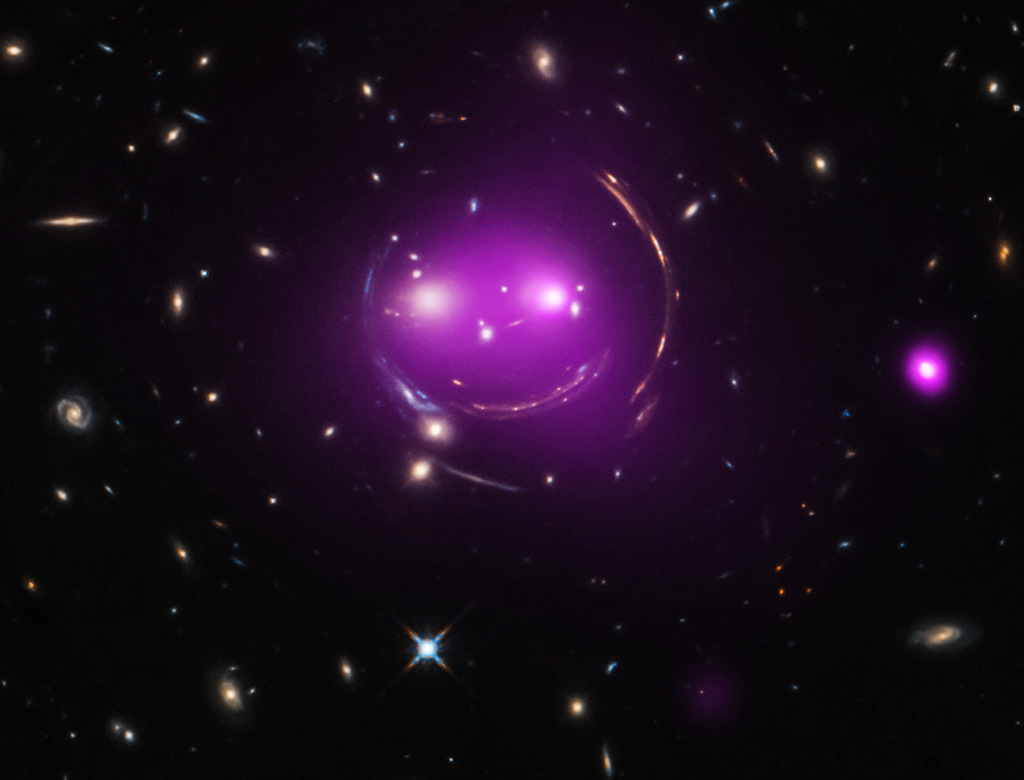 |
| "Chester Cat" Galaxy group Image Credit: X-ray - NASA / CXC / J. Irwin et al. ; Optical - NASA/STScI NASA/APOD |
The arcs are optical images of distant background galaxies lensed by the foreground group's total distribution of gravitational mass dominated by dark matter.
In fact the two large elliptical "eye" galaxies represent the brightest members of their own galaxy groups which are merging. Their relative collisional speed of nearly 1,350 kilometers/second heats gas to millions of degrees producing the X-ray glow shown in purple hues.
NASA/APOD
Gravitational lens
A gravitational lens refers to a distribution of matter (such as a cluster of galaxies) between a distant source and an observer, that is capable of bending the light from the source, as it travels towards the observer.
This effect is known as gravitational lensing and the amount of bending is one of the predictions of Albert Einstein's general theory of relativity. (Classical physics also predicts bending of light, but only half that of general relativity's.
Although Orest Chwolson (1924) or Frantisek Klin (1936) are sometimes credited as being the first ones to discuss the effect in print, the effect is more commonly associated with Einstein, who published a more famous article on the subject in 1936.
Fritz Zwicky posited in 1937 that the effect could allow galaxy clusters to act as gravitational lenses.
It was not until 1979 that this effect was confirmed by observation of the so-called "Twin QSO" SBS 0957+561.
Wikipedia
The Twin Quasar
 |
| "QSO B0957+0561" by ESA/Hubble & NASA Licensed under Public Domain via Commons |
Einstein and God
No - I am not going to argue here about Albert Einstein's Jewish heritage or his relationship with the God of Israel. The point I am emphasizing has nothing to do with Einstein's personal views on science and religion.
The theological significance of gravitational lensing is in the way the phenomenon was discovered. So many things in Creation have been found by careful observation, logical theory formation, testing and double-checking the observation. But not in this case. Einstein figured out gravitational lensing by pure mathematical thinking without any experimental evidence at hand.
It is remarkable, that while Einstein suggested the bending of light already in the general theory of relativity in 1915, the conclusive proof that he was right was found 61 years later in 1976. Accordingly, there is a hiatus of more than half a century before such equipment had been engineered that could be used to test experimentally this particular aspect in Einstein's theory. But even with best instruments it was still not a simple matter to find that needle in the haystack, evidence of gravitational lensing among billions of stars and galaxies.
The quasars QSO 0957+561A/B were discovered in early 1979 by an Anglo-American team around Dennis Walsh (1933–2005), Robert Carswell and Ray Weyman, with the aid of the 2.1 m Telescope at Kitt Peak National Observatory in Arizona/USA. The team noticed that the two quasars were unusually close to each other, and that their redshift and visible light spectrum were surprisingly similar. They published their suggestion of "the possibility that they are two images of the same object formed by a gravitational lens".In the New Testament we have a genuine letter that was written by apostle Paul to the Christians in the capital of Rome in the 50'ies AD. Paul is inspired by the Holy Spirit while writing and scribbles down on papyrus immortal words about the God of Israel - for there is no other real God. while talking about the fallen state of humanity Paul emphasizes the deep thinking of the Creator which is obvious to all in His works. In modern terms we can express this by saying that Creation reflects the mathematical genius of the Creator.
Wikipedia
For since the creation of the world God’s invisible qualities—his eternal power and divine nature—have been clearly seen, being understood from what has been made, so that people are without excuse.With his extraordinary brain Einstein figured out in his mind in a radically new way gravity fields and concluded that they also bend light. Because he achieved this feast just by thinking something in his mind must have reflected the deep reality of the Creation.
Romans 1:20 NIV
I do not want to use this "found by thinking" argument as proof that God exists as has been done by many over the centuries. Because true faith in God does not come from intelligent reasoning - it is born from the Word of God and is a gift given to some. However, gravitational lensing has spirituality and even holiness, the nobility and genius of human mind at its sharpest and the sanctity of God of Israel, who has created that mind.
Wednesday, November 25, 2015
Lyra - GSC 02652-01324 and planet TrES-1b
 |
| "Exoplanet Comparison TrES-1 b" by Aldaron, a.k.a. Aldaron - Own work, Licensed under CC BY-SA 3.0 via Commons |
Guide Star Catalog
The Guide Star Catalog (GSC) is also known as the Hubble Space Telescope, Guide Catalog (HSTGC). It is a star catalog compiled to support the Hubble Space Telescope with targeting off-axis stars.
GSC-I contained approximately 20,000,000 stars with apparent magnitudes of 6 to 15. GSC-II contains 945,592,683 stars out to magnitude 21. As far as possible, binary stars and non-stellar objects have been excluded or flagged as not meeting the requirements of Fine Guidance Sensors. This is the first full sky star catalog created specifically for navigation in outer space.
Wikipedia
TrES-1b - a hot Jupiter
In 2004 the extrasolar planet TrES-1b was found to be orbiting this star by the Trans-Atlantic Exoplanet Survey using the transit method. The planet was detected crossing its parent star using a small 4-inch-diameter (100 mm) telescope. The discovery was confirmed by the Keck Observatory using the radial velocity method, allowing its mass to be determined.
The Trans-atlantic Exoplanet Survey or TrES, uses three 4-inch (10 cm) telescopes located at Lowell Observatory, Palomar Observatory, and the Canary Islands to locate exoplanets.
TrES-1b mass and radius indicate that it is a Jovian planet with a similar bulk composition to Jupiter. Unlike Jupiter, but similar to many other planets detected around other stars, TrES-1 is located very close to its star, and belongs to the class of planets known as hot Jupiters.
On March 22, 2005, Astronomers using NASA's Spitzer Space Telescope took advantage of the discovery to directly capture the infrared light of two previously detected planets orbiting outside our solar system. Their findings revealed the temperatures and orbits of the planets.
Upcoming Spitzer observations using a variety of infrared wavelengths may provide more information about the planets' winds and atmospheric compositions. It enabled determination of TrES-1's temperature, which is in excess of 1000 K (1340 °F). The planet's Bond albedo was found to be 0.31 ± 0.14.
Wikipedia
Albedo
Albedo or reflection coefficient, is derived from Latin albedo "whiteness" (or reflected sunlight) in turn from albus "white", is the diffuse reflectivity or reflecting power of a surface. It is the ratio of reflected radiation from the surface to incident radiation upon it.
Its dimensionless nature lets it be expressed as a percentage and is measured on a scale from zero for no reflection of a perfectly black surface to 1 for perfect reflection of a white surface.
Albedo depends on the frequency of the radiation. When quoted unqualified, it usually refers to some appropriate average across the spectrum of visible light.
Wikipedia
____________
Click on the links provided under the snippets to get more details about the subjects and references.
Tuesday, November 24, 2015
Lyra - Stars with planets and Doppler spectroscopy
| Image Quora.com |
HD 177830
HD 177830 is a 7th magnitude star located approximately 193 light-years away in the constellation of Lyra. It is slightly more massive than our Sun, but cooler being a type K star. Therefore, it is a subgiant clearly more evolved than the Sun. In visual light it is four times brighter than the Sun, but because of its distance, about 193 light years, it is not visible to the unaided eye. With binoculars it should be easily visible.
Wikipedia
HD 173416
Visible to the naked eye are HD 173416, a yellow giant hosting a planet over twice the mass of Jupiter discovered in 2009.
HD 176051
HD 176051 is a low-mass binary star containing a high-mass planet.
Wikipedia
Discovery
On November 14, 1999, the discovery of a planet HD 177830 b was announced by the California and Carnegie Planet Search team using the very successful radial velocity method along with two other planets. This planet is nearly 50% more massive than Jupiter (MJ) and takes 407 days to orbit the star in an extremely circular orbit.
On November 17, 2010, the discovery of a second planet HD 177830 c was announced along with four other planets. The planet has 50% the mass of Saturn and takes 111 days to orbit the star in a very eccentric orbit. This planet is in a near 4:1 resonance with the outer planet.
Wikipedia
Doppler spectroscopy
 |
| "Doppler Shift vs Time" by Dan Wingard Licensed under Public Domain via Commons |
Doppler spectroscopy (also known as the radial-velocity method, or colloquially, the wobble method) is an indirect method for finding extrasolar planets and brown dwarfs from radial-velocity measurements via observation of Doppler shifts in the spectrum of the planet's parent star.
About half of the extrasolar planets known were discovered using Doppler spectroscopy, as of October 2012.
A series of observations is made of the spectrum of light emitted by a star. Periodic variations in the star's spectrum may be detected, with the wavelength of characteristic spectral lines in the spectrum increasing and decreasing regularly over a period of time.
Statistical filters are then applied to the data set to cancel out spectrum effects from other sources.
Using mathematical best-fit techniques, astronomers can isolate the tell-tale periodic sine wave that indicates a planet in orbit.
If an extrasolar planet is detected, a minimum mass for the planet can be determined from the changes in the star's radial velocity.
To find a more precise measure of the mass requires knowledge of the inclination of the planet's orbit. A graph of measured radial velocity versus time will give a characteristic curve (sine curve in the case of a circular orbit), and the amplitude of the curve will allow the minimum mass of the planet to be calculated.
Although radial-velocity of the star only gives a planet's minimum mass, if the planet's spectral lines can be distinguished from the star's spectral lines then the radial-velocity of the planet itself can be found and this gives the inclination of the planet's orbit and therefore the planet's actual mass can be determined. The first non-transiting planet to have its mass found this way was Tau Boötis b in 2012 when carbon monoxide was detected in the infra-red part of the spectrum
Wikipedia
__________
Read the articles quoted from Wikipedia for much additional information and references.
Sunday, November 22, 2015
Lyra - Abell 46 and the Abell Planetary Catalog
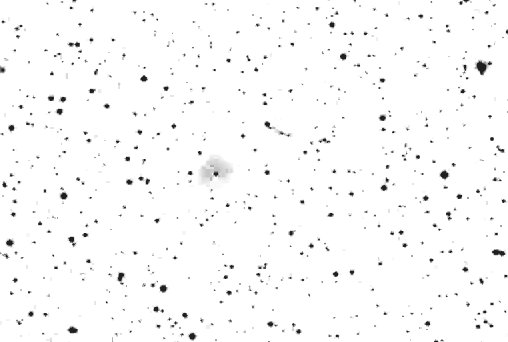 |
| Abell 46 Image Steve Gottlieb |
The Abell Catalog of Planetary Nebulae was created in 1966 by UCLA astronomer George O. Abell (1927–1983) and was composed of 86 entries thought to be planetary nebulae that were collected from discoveries, about half by Albert George Wilson and the rest by Abell, Robert George Harrington, and Rudolph Minkowski.
 |
| "P48 1994 Jean Large" by Picture scanned from the original by Michael Vergara Licensed under CC BY-SA 3.0 via Commons |
Wikipedia
Observing notes by Steve Gottlieb
Planetaries on the Abell list are best viewed with a large aperture telescope (e.g. 18-inch (0.46 m)) and an OIII filter.
Summer: 17.5: at 200x and 140x using an OIII filter appears faint, moderately large, ~50" diameter, round. Can hold continuously with averted vision and visible with direct vision. Did not look unfiltered for the mag 15 central star.
13: at 79x with OIII filter appears extremely faint, moderately large, 1.0' diameter, almost round, can barely hold steadily. Just visible using a UHC visible although appears near the visual threshold.
Steve Gottlieb
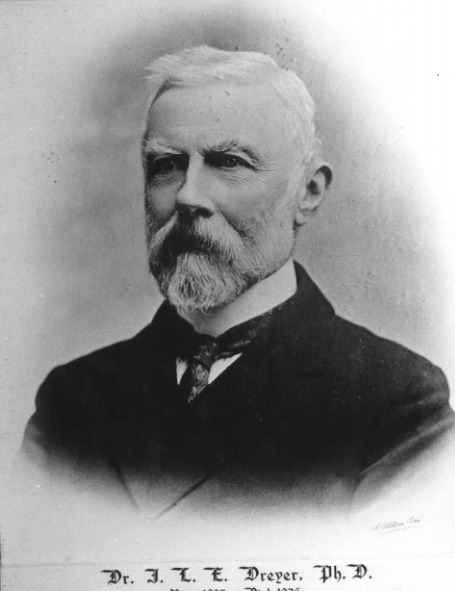
NGC and John Dreyer
 |
| "John Dreyer" by Unknown Licensed under Public Domain via Commons |
The New General Catalogue of Nebulae and Clusters of Stars (abbreviated as NGC) is a well-known catalogue of deep-sky objects in astronomy compiled by John Louis Emil Dreyer in 1888, as a new version of John Herschel's Catalogue of Nebulae and Clusters of Stars.
The NGC contains 7,840 objects, known as the NGC objects. It is one of the largest comprehensive catalogues, as it includes all types of deep space objects and is not confined to, for example, galaxies.
Dreyer published two supplements to the NGC, known as the Index Catalogues (abbreviated as IC). The first was published in 1895 and contained 1,520 objects, while the second was published in 1908 and contained 3,866 objects, for a total of 5,386 IC objects.
Objects in the sky of the southern hemisphere are catalogued somewhat less thoroughly, but many were observed by John Herschel or James Dunlop.
The NGC had many errors, but a serious if not complete attempt to eliminate them has been initiated by the NGC/IC Project in 1993, after partial attempts with the Revised New General Catalogue (RNGC) by Jack W. Sulentic and William G. Tifft in 1973, and NGC2000.0 by Roger W. Sinnott in 1988.
The Revised New General Catalogue and Index Catalogue was compiled in 2009 by Wolfgang Steinicke.
Wikipedia
John Dreyer
John Louis Emil Dreyer (1852 – 1926) was a Danish-Irish astronomer.
During 1878 he moved to Dunsink, the site of the Trinity College Observatory of Dublin University to work for Robert Stawell Ball.
In 1882 he relocated again, this time to Armagh Observatory, where he served as Director until his retirement in 1916.
In 1885 he became a British citizen. In 1916 he and his wife Kate moved to Oxford where Dreyer worked on his 15 volume edition of the works of Tycho Brahe, the last volume of which was published after his death.
He won the Gold Medal of the Royal Astronomical Society in 1916 and served as the society's president from 1923 until 1925.
History of the Planetary Systems from Thales to Kepler (1905), his survey of the history of astronomy, while dated in some respects, is still a good introduction to the subject. It is currently printed with the title A History of Astronomy from Thales to Kepler (available on-line).
A crater on the far side of the Moon is named after him.
Wikipedia
Lyra - NGC 6745 Irregular galaxy
 |
| "NGC 6745" by NASA Goddard Space Flight Center NASA-GSFC The Goddard Library. Licensed under Public Domain via Commons |
NGC 6745 (also known as UGC 11391) is an irregular galaxy about 206 million light-years (63.5 mega-parsecs) away in the constellation Lyra. It is actually a triplet of galaxies in the process of colliding.
The three galaxies have been colliding for hundreds of millions of years. After passing through the larger galaxy (NGC 6745A), the smaller one (NGC 6745B) is now moving away. The larger galaxy was probably a spiral galaxy before the collision, but was damaged and now appears peculiar.
The collision created a region filled with young, hot, blue stars visible in the photo above.
It is unlikely that any stars in the two galaxies collided directly because of the vast distances between them. The gas, dust, and ambient magnetic fields of the galaxies, however, do interact directly in a collision. As a result of this interaction, the smaller galaxy has probably lost most of its interstellar medium to the larger one.
Wikipedia
Friday, November 20, 2015
Lyra - Alathfar and spectral class A
 |
| Fomalhaut,(Alpha Piscis Austrini) is an A3 main-sequence star "Heic0821f" by Davide De Martin Licensed under Public Domain via Commons |
Mu Lyrae (μ Lyr, μ Lyrae) is main-sequence dwarf star with apparent magnitude 5.12. It belongs to the spectral class A0IV. Located around 439 light-years distant, it shines with a luminosity approximately 125 times that of the Sun and has a surface temperature of 8190 K.
The star has the traditional name Alathfar, from the Arabic الأظفر al-’uz̧fur "the talons (of the swooping eagle)", a name it shares with Eta Lyrae (usually spelled with d instead of th: Aladfar).
Wikipedia
Let me repeat: luminosity of 125 times that of the Sun.
A-type stars
These are among the more common naked eye stars and are white or bluish-white.
They have strong hydrogen lines, at a maximum by A0, and also lines of ionized metals (Fe II, Mg II, Si II) at a maximum at A5. The presence of Ca II lines is notably strengthening by this point.
About 1 in 160 (0.625%) of the main-sequence stars in the solar neighborhood are A-type stars.
Spectral standards:
- A0Van: Gamma Ursae Majoris
- A0Va: Vega
- A0Ib: Eta Leonis
- A0Ia: HD 21389
- A2Ia: Deneb
- A3Va: Fomalhaut
Thursday, November 19, 2015
Lyra - Aladfar η Lyrae Blue subgiant
.jpg/800px-Alcyon_(star).jpg) |
| Alcyone, Pleiades, is a typical blue giant NASA, ESA, AURA/Caltech, Palomar Observatoryderivative work: Roberto Segnali all'Indiano - Pleiades_large.jpg. Licensed under Public Domain via Commons |
Eta Lyrae is a blue subgiant with nearly similar metal abundance to Sun. The star belongs to spectral class B2.5IV and has apparent magnitude of +4.40. It is approximately 1390 light years from Earth.
The originally Arabic name Aladfar الأظفر al-’uz̧fur means "the talons (of the swooping eagle)" with Arab astronomers association of Lyra with an eagle.
Wikipedia
Blue giants
 |
| Blue giant Bellatrix compared to Algol B, the Sun, a red dwarf, and some planets Image by User:84user, User:Paul Stansifer and others Licensed under GPLv2 via Commons |
The name is applied to a wide variety of different types of stars with a moderate increase in size and luminosity compared to main-sequence stars of the same mass or temperature, and are hot enough to be called blue, meaning spectral class O, B, and sometimes early A.
Stars found in the blue giant region of the HR diagram can be in very different stages of their lives, but all are evolved stars that have largely exhausted their core hydrogen supplies.
Blue giants are much rarer than red giants, because they only develop from more massive and less common stars, and because they have short lives in the blue giant stage.
Wikipedia
 |
| Hertzsprung–Russell diagram by User:Rursus. Licensed under CC BY-SA 3.0 via Commons |
Tuesday, November 17, 2015
Lyra - M57 Planetary nebula
 |
| Messier 57 Ring Nebula by Hubble Space Telescope "M57 The Ring Nebula" by The Hubble Heritage Team (AURA/STScI/NASA) Licensed under Public Domain via Commons |
 |
| "Antoine Darquier de Pellepoix" by G. Vidal Licensed under Public Domain via Commons |
- The central star is a white dwarf with a temperature of 120,000 Kelvin.
- The outer part of the nebula appears red in photographs because of emission from ionized hydrogen.
- The middle region is colored green; doubly ionized oxygen emits greenish-blue light.
- The hottest region, closest to the central star, appears blue because of emission from helium.
 |
| Location of M57 Sky map Wikimedia |
Planetary nebulae
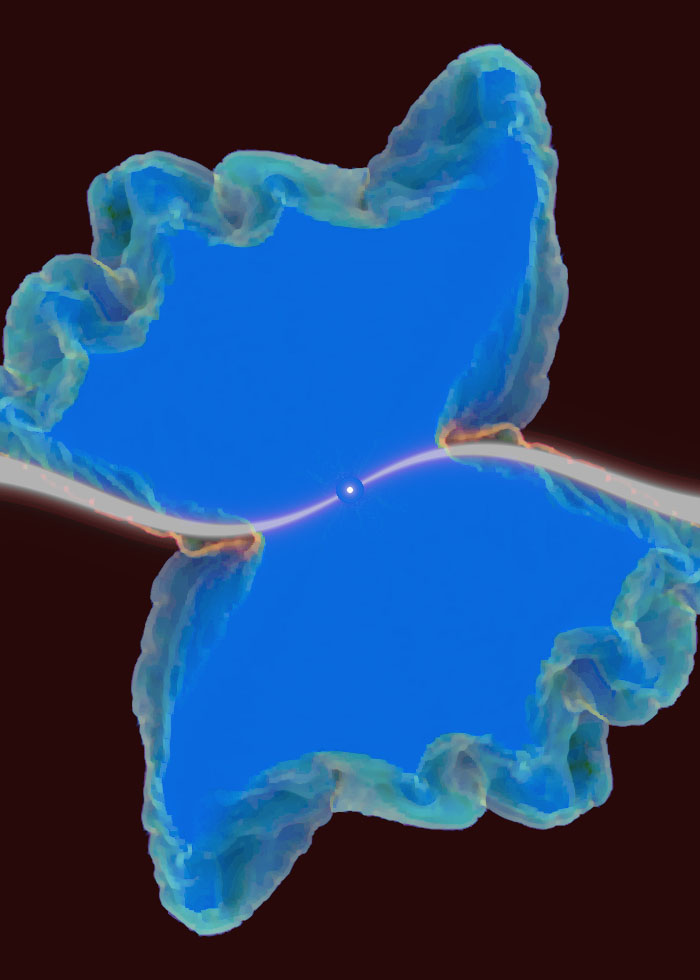 |
| Computer simulation of the formation of a planetary nebula from a star with a warped disk, showing the complexity which can result from a small initial asymmetry. Credit: Vincent Icke Huygens Laboratory, Leiden University, Netherlands Licensed under CC BY-SA 3.0 via Commons |
A planetary nebula is a kind of emission nebula consisting of an expanding glowing shell of ionized gas ejected from old red giant stars late in their lives. They are a relatively short-lived phenomenon, lasting a few tens of thousands of years, compared to a typical stellar lifetime of several billion years.
At the end of the star's life, during the red giant phase, the outer layers of the star are expelled by strong stellar winds. Eventually, after most of the red giant's atmosphere is dissipated, the exposed hot, luminous core emits ultraviolet radiation to ionize the ejected outer layers of the star. Absorbed ultraviolet light energises the shell of nebulous gas around the central star, appearing as a bright coloured planetary nebula at several discrete visible wavelengths.
Planetary nebulae may play a crucial role in the chemical evolution of the Milky Way, returning material to the interstellar medium from stars where elements, the products of nucleosynthesis (such as carbon, nitrogen, oxygen and neon), have been created.
Planetary nebulae are also observed in more distant galaxies, yielding useful information about their chemical abundances.
In recent years, Hubble Space Telescope images have revealed many planetary nebulae to have extremely complex and varied morphologies. About one-fifth are roughly spherical, but the majority are not spherically symmetric. The mechanisms which produce such a wide variety of shapes and features are not yet well understood, but binary central stars, stellar winds and magnetic fields may play a role.
Wikipedia
___________
Click on the links provided for detailed discussions on the subjects and for references.
Monday, November 16, 2015
Lyra - Globular cluster Messier 56 and Dwarf galaxies
 |
| M56 Glubar cluster by Hubble Space Telescope "Messier 56 Hubble WikiSky" by en:NASA, en:STScI icensed under Public Domain via Commons |
Messier 56 (NGC 6779) is a globular cluster at a distance of about 32,900 light-years from Earth and measures roughly 84 light-years across, with a combined mass some 230,000 times that of the Sun. It is about 31–32 kly (9.5–9.8 kpc) from the Galactic Center and 4.8 kly (1.5 kpc) above the galactic plane. The cluster has an estimated age of 13.70 billion years and is following a retrograde orbit through the Milky Way.
 |
| "Charles Messier at Age of 40" by Ansiaume (1729—1786) Licensed under Public Domain via Commons |
The properties of this cluster suggest that it may have been acquired during the merger of a dwarf galaxy, of which Omega Centauri forms the surviving nucleus. The abundance of elements other than hydrogen and helium (metallicity) has a very low value of [Fe/H] = –2.00 dex. This is equivalent to 1% of the abundance in the Sun.
The brightest stars in M56 are of 13th magnitude, while it contains only about a dozen known variable stars, such as V6 (RV Tauri star; period: 90 days) or V1 (Cepheid: 1.510 days); Other variable stars are V2 (irregular) and V3 (semiregular).
In 2000, a diffuse X-ray emission was tentatively identified coming from the vicinity of the cluster. This is most likely interstellar medium that has been heated by the passage of the cluster through the galactic halo. The relative velocity of the cluster is about 177 km s−1, which is sufficient to heat the medium in its wake to a temperature of 940,000 K..
Wikipedia
Globular clusters
A globular cluster is a spherical collection of stars that orbits a galactic core as a satellite.
Globular clusters are very tightly bound by gravity, which gives them their spherical shapes and relatively high stellar densities toward their centers. They are found in the halo of a galaxy and contain considerably more stars and are much older than the less dense galactic, or open clusters, which are found in the disk.
Every galaxy of sufficient mass in the Local Group has an associated group of globular clusters, and almost every large galaxy surveyed has been found to possess a system of globular clusters. There are about 150 to 158 currently known globular clusters in the Milky Way, with perhaps 10 to 20 more still undiscovered. They orbit the Galaxy at radii of 40 kiloparsecs (130,000 light-years) or more. Larger galaxies can have more: Andromeda, for instance, may have as many as 500. Some giant elliptical galaxies, particularly those at the centers of galaxy clusters, such as M87, have as many as 13,000 globular clusters.
The Sagittarius Dwarf galaxy and the disputed Canis Major Dwarf galaxy appear to be in the process of donating their associated globular clusters (such as Palomar 12) to the Milky Way. This demonstrates how many of this galaxy's globular clusters might have been acquired in the past.
Although it appears that globular clusters contain some of the first stars to be produced in the galaxy, their origins and their role in galactic evolution are still unclear. It does appear clear that globular clusters are significantly different from dwarf elliptical galaxies and were formed as part of the star formation of the parent galaxy rather than as a separate galaxy. However, recent conjectures by astronomers suggest that globular clusters and dwarf spheroidals may not be clearly separate and distinct types of objects.
Wikipedia
Dwarf Galaxies
 |
| GALEX. artist's view image Licensed under Public Domain via Commons |
A dwarf galaxy is a small galaxy composed of up to several billion stars, a small number compared to our own Milky Way's 200–400 billion stars. The Large Magellanic Cloud, which closely orbits the Milky Way and contains over 30 billion stars, is sometimes classified as a dwarf galaxy; others consider it a full-fledged galaxy.
Dwarf galaxies' formation and activity are thought to be heavily influenced by interactions with larger galaxies. Astronomers identify numerous types of dwarf galaxies, based on their shape and composition.
Current theory states that most galaxies, including dwarf galaxies, form in association with dark matter, or from gas that contains metals. However, NASA's Galaxy Evolution Explorer space probe identified new dwarf galaxies forming out of gases lacking metals. These galaxies were located in the Leo Ring, a cloud of hydrogen and helium around two massive galaxies in the constellation Leo.
Because of their small size, dwarf galaxies have been observed being pulled toward and ripped by neighbouring spiral galaxies, resulting in galaxy merger.
Wikipedia
____________
Click on the given links for more detailed discussions and references.
Subscribe to:
Posts (Atom)