Showing posts with label Galileo Galilei. Show all posts

Tuesday, September 20, 2011

Bible and Origins of life

 Cassini-Huygen's probe on Titan 2005

What has the ancient Bible to do with questions of modern astrobiological search for the origins of life in the Universe?

Well, first of all let us beware of the mistakes from the past where people of Church have ridiculed and even persecuted scientists looking for truth about Nature. Galileo and Darwin spoke the truth as they understood it and the zealous defenders of Bible were wrong.


Monotheism
Bible was written by people sharing an early form of geocentric worldview prevalent in Ancient Near East.

Yet, as Word of God the two creation stories at the beginning of the Bible are not exactly products of their time and have an alluring eternal wisdom embedded into them.

Genesis is a slaughterhouse of gods and divinities.

Ancient Egyptians worshiped Sun, Sumerians worshiped Moon, Babylonians worshiped Venus, Ishtar, the Evening Star, and the famed Romans worshiped Sun invictus still in the Byzantine era. Inka's and Maya's give divine respect to the bright Sun and so on....

In total opposition to the learned people in the highest ancient civilizations Bible says that these are not divine beings to be worshiped but practical lamps for day and night, calendars and watches created by the One benevolent God for the good of humanity.

Creation of life

Then God said, “Let the waters below the heavens be gathered into one place, and let the dry land appear”; and it was so.  God called the dry land earth, and the gathering of the waters He called seas; and God saw that it was good.  Then God said, “Let the earth sprout vegetation, plants yielding seed, and fruit trees on the earth bearing fruit after their kind with seed in them”; and it was so.

The earth brought forth vegetation, plants yielding seed after their kind, and trees bearing fruit with seed in them, after their kind; and God saw that it was good. There was evening and there was morning, a third day."
Genesis 1:9-13

The earth brought forth vegetation
First Creation story in the beginning of the Bible tells how waters and land were separated and then first living things are produced by earth.

Paleo-sciences teach us today that life flourished first in the oceans and only much later climbed up to the exposed land.


The ancient writer of the Creation story may have looked on the green nature around him, fields and gardens near Iron Age Jerusalem and he tells us what he sees - how earth brings fourth vegetation, plants yielding seed, and fruit trees.

Bible is not an accurate description of this and places green plants on earth before the creation of the Sun and in our study of biological history of life flowering plants are latecomers on our planet.

Common housefly and "locked evolution of species"

Origins of species
Bible has an intriguing expression, not so different from the challenging "leminehu", created "after its kind" ... what we would call "according to its species".  God created the living things, plants and animals, according to their species (heb. leminehu).

We understand the mechanism of natural selection and put it in good use. We know a bit more about hereditary patterns, we can use it to our good and get our cows to produce more milk, genetically enhance our wheat and make maize bigger.

Nevertheless, one hundred and sixty years after Charles Darwin's revolutionary scientific theory of evolution (Origin of Species 1853) humanity has taken enormous steps in studying life but has very limited understanding about the origins of species.

Nobel price is still waiting the biologists who can explain the locking system of species on the functioning of reproductive cells. Practically the same house fly was bothering Tyrannosaurus Rex as is bothering our summer picnic meal and the species has remained locked as a species for the past 200 million years. Of course, there are many kinds of flies as there are many kinds of monkeys, us included, but nobody really knows the mechanism that keeps the babies of a horse and a donkey barren (mule's do not get kids). There is still work to be done on leminehu.


Planting of the Garden of Eden and man
The second Creation story tells in mythological tones how God made man from earth.  Hebrew word adamah means the reddish fertile soil made from the Eocene limestone. Adam, the first man, carries the name reminding him of his origins in the clay.

"Then the LORD God formed man of dust from the ground, and breathed into his nostrils the breath of life; and man became a living being. The LORD God planted a garden toward the east, in Eden; and there He placed the man whom He had formed. Out of the ground the LORD God caused to grow every tree that is pleasing to the sight and good for food; the tree of life also in the midst of the garden, and the tree of the knowledge of good and evil."
Genesis 2:7-9

Again this ... out of soil, dust, adamah.

Titan, Canyon country

Gaia, mother Earth!
We all instinctively realize that early Universe was hostile to life and that somehow nevertheless appears in the cosmos at some point.

For example, our own Solar system was created about one third of the total estimated age of the Universe 4.5 billion years ago. Signs of life are said to be found in the rocks on the crust of the planet some 3 billion years ago. Life really exploded some 600 million years ago in the Cambrian era.

Astrobiologists look also at extreme areas on Earth, its molecules, environments, test the impact of electric shocks from flashing, try to recreate a place where they could ignite life out of inorganic elements like we humans know to ignite fire from not burning elements.

One of the more interesting searches for the origin of life in resent years is the Cassini-Huygens exploration of the atmosphere of Titan in 2005, the rocky moon of Saturn. The idea is that the archaic freezing conditions prevailing at Titan might resemble early solar system and Earth and possibly provide clues for the origins of life.

Genesis is written in monotheistic faith and leaves no room for a divine thinking and creating Earth, Gaia.

But the idea that Earth produces life is definitely to be found in the Bible.

Thursday, March 26, 2009

WYSIWYG - Galileo Galilei

Galileo Galilei (1564-1642)


What You See Is What You Get.

The entire humanity was limited to the amazing capacities of eyesight. In dark clear night thousands of stars of different brightness made the sky so beautiful. Constellations helped sailors in their navigation on open sees as they helped birds in their flight from one continent to another. The main planets followed their regular paths across the night sky and had been the focus of human worship in ancient times carrying the names of old gods. There was the mighty Jupiter, bright Saturn, reddish Mars, lovely evening star Venus dancing with the moon.

Ptolemy had defined the routes and movements of stars and planets on the flat sky in a way that satisfied even the most curious star watchers for over a thousand years. With only a few exceptions, they followed the - sometimes quite complicated - paths he had recorded in his book.


Galilei's telescope 1601 magnified the view 14x

Then something happened. The human race was given a device that multiplied the power of human eye.

The invention was made in Netherlands. In 1609 Galileo Galilei (1564-1642) heard that a Dutch optician Lippershey had used polished glass to see objects that are further away. Next year, 1610, Galileo had made for himself a similar device, a 1330 mm long tube made of copper, wood and paper and with two polished glasses in a simple refractor. The diameter of the lens was 26 mm and on the other end of the tube there was an eyepiece. Galilei's telescope magnified the view a whopping 14 times. Galileo prepared several such instruments in Pisa between 1610-1614 and in 1619 he invented microscope. In 1611 prince Federico Cesei named the device telescope (tele scopia, see far).

Well, most of us would probably be satisfied looking at our neighbourhood. But Galileo pointed the first telescope to the sky and made some stunning observations.

The moon was not a perfect circle completely different from good old earth. It had mountains and valleys and planes just like earth. Galileo was the first human to see four moons around Jupiter. These Galilean moons are called Io, Europa, Callisto and Ganymede. He made accurate observations about their visibility in his book Sidereus Nuncius in order to help sailors navigating on the open seas. It is amazing what he achieved with that telescope. Children have better binoculars today. An example of the low quality of the instrument is that it did not differentiate between Saturn and its rings so Galileo suggested that the planet has strange "horns" attached to its sides.


When Galileo saw what he saw there was an ongoing scientific controversy. If Tyco Brahe and Nicolaus Copernicus (1473-1543) were right that planets circulate Sun they should show moon faces, from crescents to full moon. With his primitive telescope Galileo was able to see that this was indeed the case!

But the big surprise waiting for this genius was the Sun. Wisely he did not aim the telescope at it and loose his eyesight. He projected sunlight through the telescope to a paper. To his amazement he not only noticed dark spots on the surface of the Sun but these were moving in a manner that indicated that the Sun itself is turning around its axis.

What You See Is What You Get.

But the church leaders of Galileo's time were not ready to look.

In 1615 during the rule of Pope Paul V Galileo Galilei was summoned to Vatican to answer for his godless claims that in the pure symbol of God, the Sun, there are imperfections, black spots. Or that the Sun would be rotating or that Copernicus was right in saying that planets have orbits around the Sun.

Galileo in the Papal Court 1615

Galileo, and his brave supporter Cardinal Foscarino tried in vain to explain that the Bible is intended to show the way to heaven, not the way heavenly bodies are moving on the sky.

The court ruled that Galileo was allowed to study the hypotheses of Copernicus but not publicly claim that they were correct. It is told that after leaving the building of the inquisition Galileo said E pur si muove- it rotates anyway. The blind faith of the believers cannot stop sun from rotating.

In 1633 Galileo was again in church court for his publications and lived the rest of his life in the shadow of the inquisition. However, Pope Urbanus VII ordered that he should be given state pension and sent his papal blessing to dying Galileo in 1642.

A bit later, during the time of the enlightened Pope John Paul II, Galileo was finally vindicated by the Roman Catholic church. Over three hundred years after his death.


Luther and Copernicus
Similarly as the Pope and his scientists and theologians also the church reformer Martin Luther ridiculed Copernicus for his claims about a heliocentric solar system. For Luther these godless and stupid claims run against Biblical revelation. For how could Joshua stop the sun and the moon for that famed battle in the valley of Ayalon if that joker Nicolaus was right?

"And it came to pass, as they fled from before Israel, and were in the going down to Bethhoron, that the LORD cast down great stones from heaven upon them unto Azekah, and they died: they were more which died with hailstones than they whom the children of Israel slew with the sword.

Then spake Joshua to the LORD in the day when the LORD delivered up the Amorites before the children of Israel, and he said in the sight of Israel, Sun, stand thou still upon Gibeon; and thou, Moon, in the valley of Ajalon.

And the sun stood still, and the moon stayed, until the people had avenged themselves upon their enemies. Is not this written in the book of Jasher? So the sun stood still in the midst of heaven, and hasted not to go down about a whole day.

And there was no day like that before it or after it, that the LORD hearkened unto the voice of a man: for the LORD fought for Israel."

Joshua 10:11-14 KJVA

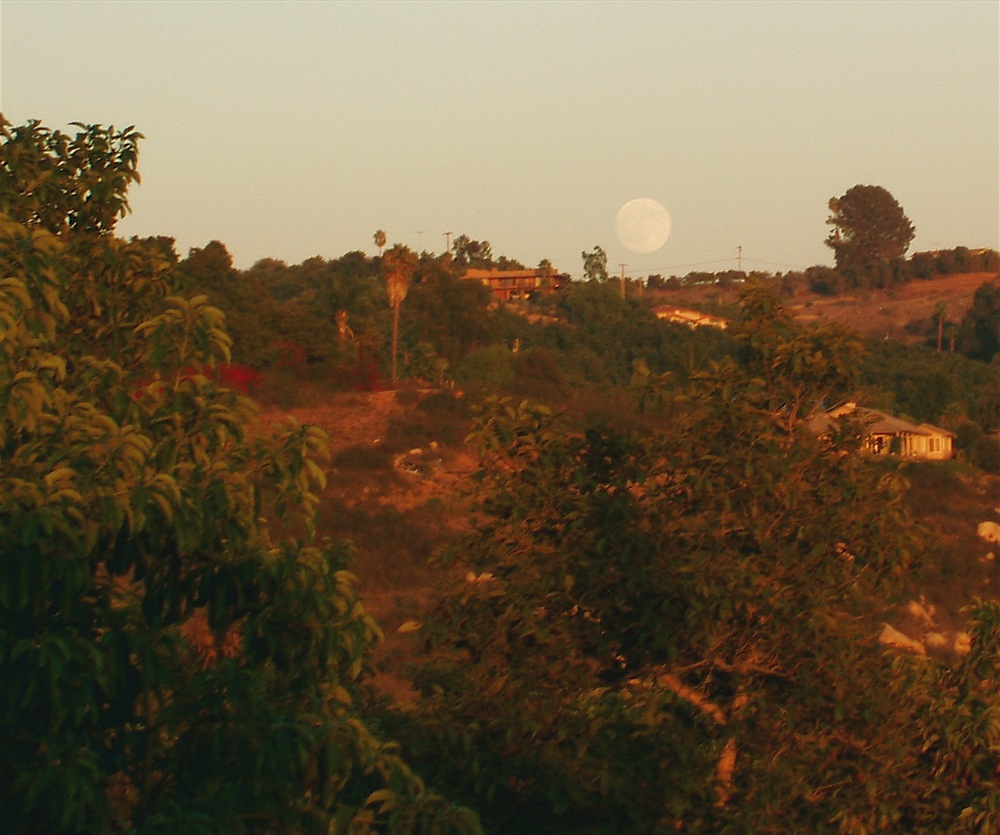
As a personal comment on this matter between Luther and Copernicus I would like to tell a personal experience here in Israel. One afternoon I was driving along a smaller road in the Valley of Ayalon towards Emmaus when I saw the setting sun in west and a full moon in East. I had to stop the car and look amazed at the spectacular sight. I have never seen anything like that elsewhere in the world. The ancient war poem of Joshua tells about sun and moon stopping - so they are visible simultaneously. I could reason that this rare sight might have inspired the fighters to slaughter even more Canaanite warriors? Of course, the Bible itself says that sun and moon stopped for a long time in order to let the required massacre of enemy to happen.

This hazy photo taken elsewhere gives some idea how it looked

Similarly, the Ayalon region is known for the unusually heavy hailstones that sometimes fall causing damage to crops. In the Biblical story God joins the battle on the side of Joshua against the Canaanite people using awe inspiring signs and miracles of the nature.


HTBWYS - Hard to Believe What You See

The case of Galileo Galilei and the Church or the Bible as the ultimate guardian of truth is a classic example of religious misbehaviour by us humans. For it is sometimes very hard to believe what one sees if it goes against what all people have believed forever. Truth has an institutional and social aspect also in learned societies as any scholar with radically new theories and discoveries can witness. The colleagues are often quite offended by ideas that show they are wrong. And not just for selfish reasons - there is something in Truth that is hard to swallow.

Copernicus was observing the movements of the planets and suggested that Ptolemy was wrong and the entire solar system was not properly understood. It is quite understandable that Luther who was totally immersed in the ancient world of Bible found such ideas simply ridiculous. Living in the first half of the 16th century Luther did not have the means or methods to check for himself the complicated calculations that led Copernicus to his revolutionary conclusions.

Galileo observed with his newly invented telescope something that the entire human race had never seen before. It is quite understandable that the blasphemy of Sun, the perfect symbol of God, was hard to accept to the scholars in Vatican.

But the inquisition had an alternative to blind faith. They could have asked Galileo to bring one of those tele-scopias with him and show the black spots of Sun in the reflected image. Or to sit with him at night and look at the moons in orbit around Jupiter giving a model of how the heavenly objects in our solar system move.

They did not want to see.

We can call this "blind faith" in the bad way. Not wanting to see what is there.

In religious circles it is not limited to 17th century scientific controversies that shake religious views of the world to the root.

And "blind faith" is not limited to the sphere of religion only.

Sometimes it is HTBWYS - Hard to Believe What You See.