Showing posts with label astrobiology. Show all posts

Sunday, November 27, 2011

Curiosity - life on Mars?


We all wish luck to the Mars Science Lab (MSL) nicknamed Curiosity on its way to the Red Planet. Because a central goal of this scientific space mission is the search for signs of microbial life it is also of exceptional theological interest.


Nov. 26, 2011: NASA began a historic voyage to Mars with the Nov. 26 launch of the Mars Science Laboratory, which carries a car-sized rover named Curiosity. Liftoff from Cape Canaveral Air Force Station aboard an Atlas V rocket occurred at 10:02 a.m. EST (7:02 a.m. PST).

"We are very excited about sending the world's most advanced scientific laboratory to Mars," NASA Administrator Charles Bolden said. "MSL will tell us critical things we need to know about Mars, and while it advances science, we'll be working on the capabilities for a human mission to the Red Planet and to other destinations where we've never been."
Quoted from NASA science page

The estimated landing of the rover on Mars is 6 August 2012 - after eight and half months of 10 km/second flight in our Solar system.

For an overview of the mission I recommend a well-written news article by BBC Science Journalist Jonathan Amos.

Gale Crater
The 2.500.000.000 dollar mission uses the latest technologies and scientific instruments in a car-sized one tonne vehicle. The research concentrates on a geological paradise, the Grand Canyon of Mars, called the 154 km in diameter Gale crater named after the Australian banker Walter Frederick Gale (1865-1945). He is the man who looked at the Red Planet and suggested that there are canals on the surface of Mars and thus intelligent life, Martians.

Picture from NASA

Gale crater is a deep scar on the surface of Mars assumed to be over two billion years old. The crater allows the examination of very deep layers of clay minerals and sulphite salts observed at the bottom. Scientists have assumed that these deposits were possibly formed as sediments in an ancient body of water. Nobody is sure - until Curiosity brings us some hard facts from the hot spot!


Interior of Mars


Earliest evidence of life on Earth has been found in pre-Cambrian granite that formed some two-three billion years when the surface of our planet was cooling and God created the lithosphere. 

Apparently Mars has no granite or basalt sphere at all. In the picture is one recent model (2003) taken from a nice description of recent theories of the inner structure of Mars by Courtney Seligman.


Astrobiologist's wet dream
The fundamental assumption of Astrobiology is that where there is water there is possibly also life as we know it. So examining 2-3 billion year old sediments formed in another planet of our Solar system... an astrobiologist's wet dream come true.

Out of the way, Cassini-Huygens and those dead frozen surfaces of Titan!

Tuesday, September 20, 2011

Bible and Origins of life

 Cassini-Huygen's probe on Titan 2005

What has the ancient Bible to do with questions of modern astrobiological search for the origins of life in the Universe?

Well, first of all let us beware of the mistakes from the past where people of Church have ridiculed and even persecuted scientists looking for truth about Nature. Galileo and Darwin spoke the truth as they understood it and the zealous defenders of Bible were wrong.


Monotheism
Bible was written by people sharing an early form of geocentric worldview prevalent in Ancient Near East.

Yet, as Word of God the two creation stories at the beginning of the Bible are not exactly products of their time and have an alluring eternal wisdom embedded into them.

Genesis is a slaughterhouse of gods and divinities.

Ancient Egyptians worshiped Sun, Sumerians worshiped Moon, Babylonians worshiped Venus, Ishtar, the Evening Star, and the famed Romans worshiped Sun invictus still in the Byzantine era. Inka's and Maya's give divine respect to the bright Sun and so on....

In total opposition to the learned people in the highest ancient civilizations Bible says that these are not divine beings to be worshiped but practical lamps for day and night, calendars and watches created by the One benevolent God for the good of humanity.

Creation of life

Then God said, “Let the waters below the heavens be gathered into one place, and let the dry land appear”; and it was so.  God called the dry land earth, and the gathering of the waters He called seas; and God saw that it was good.  Then God said, “Let the earth sprout vegetation, plants yielding seed, and fruit trees on the earth bearing fruit after their kind with seed in them”; and it was so.

The earth brought forth vegetation, plants yielding seed after their kind, and trees bearing fruit with seed in them, after their kind; and God saw that it was good. There was evening and there was morning, a third day."
Genesis 1:9-13

The earth brought forth vegetation
First Creation story in the beginning of the Bible tells how waters and land were separated and then first living things are produced by earth.

Paleo-sciences teach us today that life flourished first in the oceans and only much later climbed up to the exposed land.


The ancient writer of the Creation story may have looked on the green nature around him, fields and gardens near Iron Age Jerusalem and he tells us what he sees - how earth brings fourth vegetation, plants yielding seed, and fruit trees.

Bible is not an accurate description of this and places green plants on earth before the creation of the Sun and in our study of biological history of life flowering plants are latecomers on our planet.

Common housefly and "locked evolution of species"

Origins of species
Bible has an intriguing expression, not so different from the challenging "leminehu", created "after its kind" ... what we would call "according to its species".  God created the living things, plants and animals, according to their species (heb. leminehu).

We understand the mechanism of natural selection and put it in good use. We know a bit more about hereditary patterns, we can use it to our good and get our cows to produce more milk, genetically enhance our wheat and make maize bigger.

Nevertheless, one hundred and sixty years after Charles Darwin's revolutionary scientific theory of evolution (Origin of Species 1853) humanity has taken enormous steps in studying life but has very limited understanding about the origins of species.

Nobel price is still waiting the biologists who can explain the locking system of species on the functioning of reproductive cells. Practically the same house fly was bothering Tyrannosaurus Rex as is bothering our summer picnic meal and the species has remained locked as a species for the past 200 million years. Of course, there are many kinds of flies as there are many kinds of monkeys, us included, but nobody really knows the mechanism that keeps the babies of a horse and a donkey barren (mule's do not get kids). There is still work to be done on leminehu.


Planting of the Garden of Eden and man
The second Creation story tells in mythological tones how God made man from earth.  Hebrew word adamah means the reddish fertile soil made from the Eocene limestone. Adam, the first man, carries the name reminding him of his origins in the clay.

"Then the LORD God formed man of dust from the ground, and breathed into his nostrils the breath of life; and man became a living being. The LORD God planted a garden toward the east, in Eden; and there He placed the man whom He had formed. Out of the ground the LORD God caused to grow every tree that is pleasing to the sight and good for food; the tree of life also in the midst of the garden, and the tree of the knowledge of good and evil."
Genesis 2:7-9

Again this ... out of soil, dust, adamah.

Titan, Canyon country

Gaia, mother Earth!
We all instinctively realize that early Universe was hostile to life and that somehow nevertheless appears in the cosmos at some point.

For example, our own Solar system was created about one third of the total estimated age of the Universe 4.5 billion years ago. Signs of life are said to be found in the rocks on the crust of the planet some 3 billion years ago. Life really exploded some 600 million years ago in the Cambrian era.

Astrobiologists look also at extreme areas on Earth, its molecules, environments, test the impact of electric shocks from flashing, try to recreate a place where they could ignite life out of inorganic elements like we humans know to ignite fire from not burning elements.

One of the more interesting searches for the origin of life in resent years is the Cassini-Huygens exploration of the atmosphere of Titan in 2005, the rocky moon of Saturn. The idea is that the archaic freezing conditions prevailing at Titan might resemble early solar system and Earth and possibly provide clues for the origins of life.

Genesis is written in monotheistic faith and leaves no room for a divine thinking and creating Earth, Gaia.

But the idea that Earth produces life is definitely to be found in the Bible.

Sunday, September 18, 2011

Origins of Life

Spitzer's Orion Nebula 
NASA APOD September 17 2011

The famous Cosmic Nursery in a spectacular false-color photo taken with NASA Spitzer Space Telescope.  Jet Propulsion California Institute of Technology. "The brightest portion of the nebula is likewise centered on Orion's young, massive, hot stars, known as the Trapezium Cluster. But the infrared image also detects the nebula's many protostars, still in the process of formation, seen here in red hues."


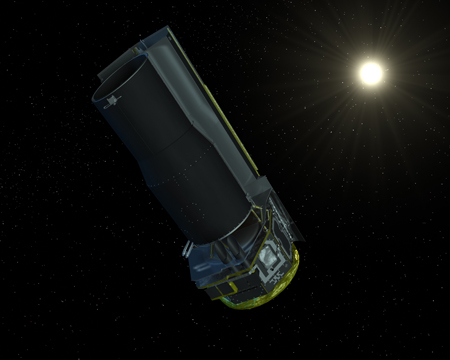
SPITZER
"The Spitzer Space Telescope is the final mission in NASA's Great Observatories Program - a family of four space-based observatories, each observing the Universe in a different kind of light. The other missions in the program include the visible-light Hubble Space Telescope (HST), Compton Gamma-Ray Observatory (CGRO), and the Chandra X-Ray Observatory (CXO)."


"Spitzer is designed to detect infrared radiation, which is primarily heat radiation. It is comprised of two major components:
The Cryogenic Telescope Assembly, which contains the a 85 centimeter telescope and Spitzer's three scientific instruments
The Spacecraft, which controls the telescope, provides power to the instruments, handles the scientific data and communicates with Earth"
(Spitzer home)


LIFE?
The Stellar Nursery of Orion Nebula is not a nice place where baby stars are quietly born. Instead, the vivid image gives us humans some feeling of the astrophysical energy, cosmic explosive chemistry, enormous gravitational forces and winds that make our worst hurricanes look minor indeed.

The image gives some indication about the Big Bang of our favorite modern theory about how everything began. Enormous forces and star formation in the midst of deadly radiation.

There really is no place for biological life in the cosmic nurseries of stars and even less in the incomprehensible Big Bang, the first Atom.

Right?

So modern scientific world view does have a description - not an explanation but a description - of how our Universe possibly began. (Of course, there is some dark stuff for the scientists yet to be clarified but work on this is progressing rapidly!)

Bessemer converter (ref)

But how on earth does life begin in this violent turbulent and inhospitable Cosmos? It is like going to a steel factory and looking for signs of life in a huge Bessemer converter in action.

That is the Big Question for humanity - what is life and how it began? For as we know it only life begets life.


HABITABLE GREEN EARTH

Green Earth (ref)

Geologists have discovered signs of life in the very inhospitable environment that prevailed on planet Earth some 3 billion years ago, only 1.5 billion years after the planet was formed and the crust had cooled down.

They tell us that life explodes during the Cambrian era some 600 million years ago first in the seas, then emerging, evolving, flourishing, withering and dying within the great order of the Geological Eras of Paleozoic, Mesozoic and Cenozoic.

We could call them modified Days of Creation.

In His majestic way God of Israel says through prophet Isaiah that He made this place habitable
(and we can comment today that "not inhabitable like Mars")

For thus says the LORD, who created the heavens (He is the God who formed the earth and made it, He established it and did not create it a waste place, but formed it to be inhabited), 
“I am the LORD, and there is none else."
 I have not spoken in secret, In some dark land; I did not say to the offspring of Jacob, ‘Seek Me in a waste place’; 
I, the LORD, speak righteousness, Declaring things that are upright."
Isaiah 45:18-20 NASB


Astrobiology

God does not tell us in His Word declaring the upright how He made this planet habitable for life and not a "waste place" כוננה לא תהו
(konena lo tohu. The word tohu is close to chaos and appears in Gen 1:1 tohu vebohu)

The great Book of Nature is open for us to study and to try to understand His marvelous works.


Excellent introductions to this not-so-simple matter of Astrobiology are the two bestsellers by Peter D. Ward and Donald Brownlee:


Rare Earth: Why Complex Life Is Uncommon in the Universe (2000)

The Life and Death of Planet Earth (2002)

Sunday, April 3, 2011

Prolegomena for Extraterrestial life - ET

Encounter of the Third Kind

Astrobiology studies life in our solar system and in outer space and is becoming an increasingly significant field of research about the origins of life on our planet. The Titan expedition was trying to find out conditions that could resemble earth some three billion years ago when the crust of our planet began to be cool enough.

This blog is not about Astrobiology but Astrotheology, Space Theology, yet I do propose some indications about what biological extraterrestial life might be. You are welcome to join in the discussion and propose additional prolegomena to my list!


1. All life originates ultimately from a single source
Creator of the entire Universe, God of Israel, is the only one who gives life. His universe is full of life.

Life cannot be generated artificially; only life begets life. Therefore modern biologists consider that the various life forms upon Earth have single point of origins.

Astronomer Sir Fred Hoyle (1915-2001) gave prominence to the Panspermia theory according to which particles of life are flying in the interstellar space in asteroids and meteroids. Such rock has hit our planet over 2 billion years ago starting life for the first time here when the environmental conditions were ripe. Additional "impregnations" may have happened since the beginning causing perhaps multiple beginnings of life or, for example, bacterial epidemics, macro evolutionary changes or have in other ways affected life on our Tellus.

Panspermia theory does not explain the origins of life - it only moves the riddle further to the deep space. Logically reversing the Big Bang of Life we can propose that all living beings in the entire Universe do originate from a single source of life.

We humans have about as good chances to explain more closely the Origin of Life as we have in explaining the state of the Universe just before the Big Bang.


2. Extraterrestial soul and intelligence is recognizable to us
According to the self-revelation of the Creator of the world in the Hebrew Bible, man and woman are together an image of the hidden and invisible God. Since all extraterrestial life having sufficient level of consciousness to communicate with the Creator is also image of God, the extraterrestial soul and intelligence is recognizable to us. So is the presence of male and female ETs!

Science-fiction tends to fill the space with human devouring alien monsters. Well - these products of human imagination are rather in the image of the adversor of God upon planet Earth, who loves to make us to murder each other in different ways.

The Search for Extraterrestial Intelligence (SETI) of the University of Berkeley is not a bad idea. It is just a very difficult attempt of finding intelligence in outer space because of the level of noise in space and the immense distances between stars and galaxies.

The Kepler space telescope has reportedly already collected data about 1200 stars that seem to have planetary system similar to our Sun. It is probable that many millions of stars even in our own Milky Way, not to speak of Andromeda, have intelligent life. And these life forms are recognizable to us and can communicate with us - maybe with Spielberg type music of close encounters - because the same God has created them who created us.


3. Biodiversity in the cosmos is beyond our imagination
Our rapidly evolved brains separates us from the rest of life upon Earth. We humbly call ourselves homo sapiens sapiens exactly for this reason - without being there we can even calculate in our brains what probably happened during the first milliseconds of Creation in the Big Bang (if there was one...). We are able to understand the strange mathematics of atomic particles and the electronic orbits and antimatter. Maybe someday we will figure out what is dark matter and energy.

Yet our imagination is limited to painting images on what we have, images that our brain is capable of producing from the input of memes and memories and observation and imagination.

God has demonstrated such immense richness of imagination when creating the biodiversity upon this planet (which we are quickly destroying in our greed for rapid and constant economic growth) that there must be myriads of life forms in the Universe that are totally beyond our imagination. Once we see one of them, we can imagine others like it.

----------
Update June 3 2012. Highly focused technique for search of intelligent life BBC article